63 recorded appearances across 19 platform families
Platform comparison
Compare the Up-Down Arrow emoji across platforms
10 platform designs
Compare ↕ in Apple, Google, Samsung and other styles. Download each available version as a transparent PNG directly from its card, or choose SVG where available. Copying the character uses the style of the receiving device.
Enhanced PNGs are reconstructed from smaller vendor artwork; the exact originals are shown above for comparison. Artwork credits & usage terms
The visual archive
Up-Down Arrow emoji design history
63 recorded appearances across 19 platform families
Follow this emoji’s recorded designs, from the earliest artwork on the left to the latest documented version on the right. Download a particular original to keep its platform design.
Original dimensions and animation are preserved. Dates labelled “Date unverified” have not been independently verified; limited-precision records show only the known month or year. Date checks identify the named release, not the first appearance of every drawing. Releases that reuse a drawing are not necessarily separate design milestones. Unavailable originals are marked on their records. How this archive is documented →
The meaning
What does the ↕ Up-Down Arrow emoji mean?
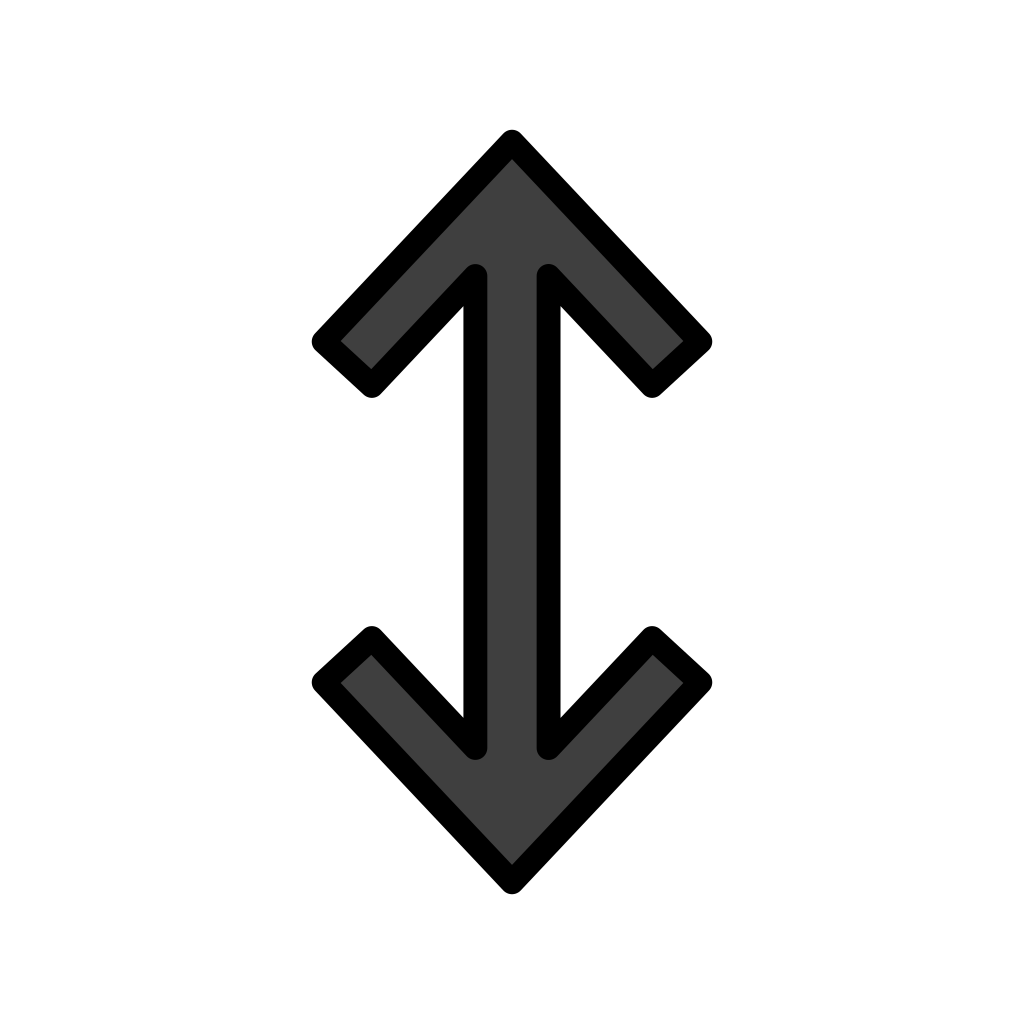
The Up-Down Arrow manifests as a vertical line capped with two opposing arrowheads, signaling bidirectional movement or verticality. It functions as a navigational glyph representing height, scrolling actions, or fluctuations in data. Its emotional neutrality makes it a versatile tool for indicating range, spatial orientation, or the concept of rising and falling within a singular context.
Common uses
Indicating physical height or the stature of an object or person.
Representing market volatility or the fluctuating value of stocks and currencies.
Instructional prompts for scrolling through long-form digital content or interfaces.
Expressing a lack of preference or indicating that a choice is 'up or down' in a binary system.
Background
Encoded by Unicode 1.1 in 1993, this glyph predates the modern emoji era. Unicode’s historical mapping data links this character to equivalent symbols in NTT DoCoMo and au by KDDI sets.
Copy ↕ to use the Unicode character; the receiving device chooses its appearance. Download an available PNG or SVG to keep a particular drawing. Historical originals retain their native bytes and dimensions. Enhanced PNGs are separately labeled generated derivatives.